
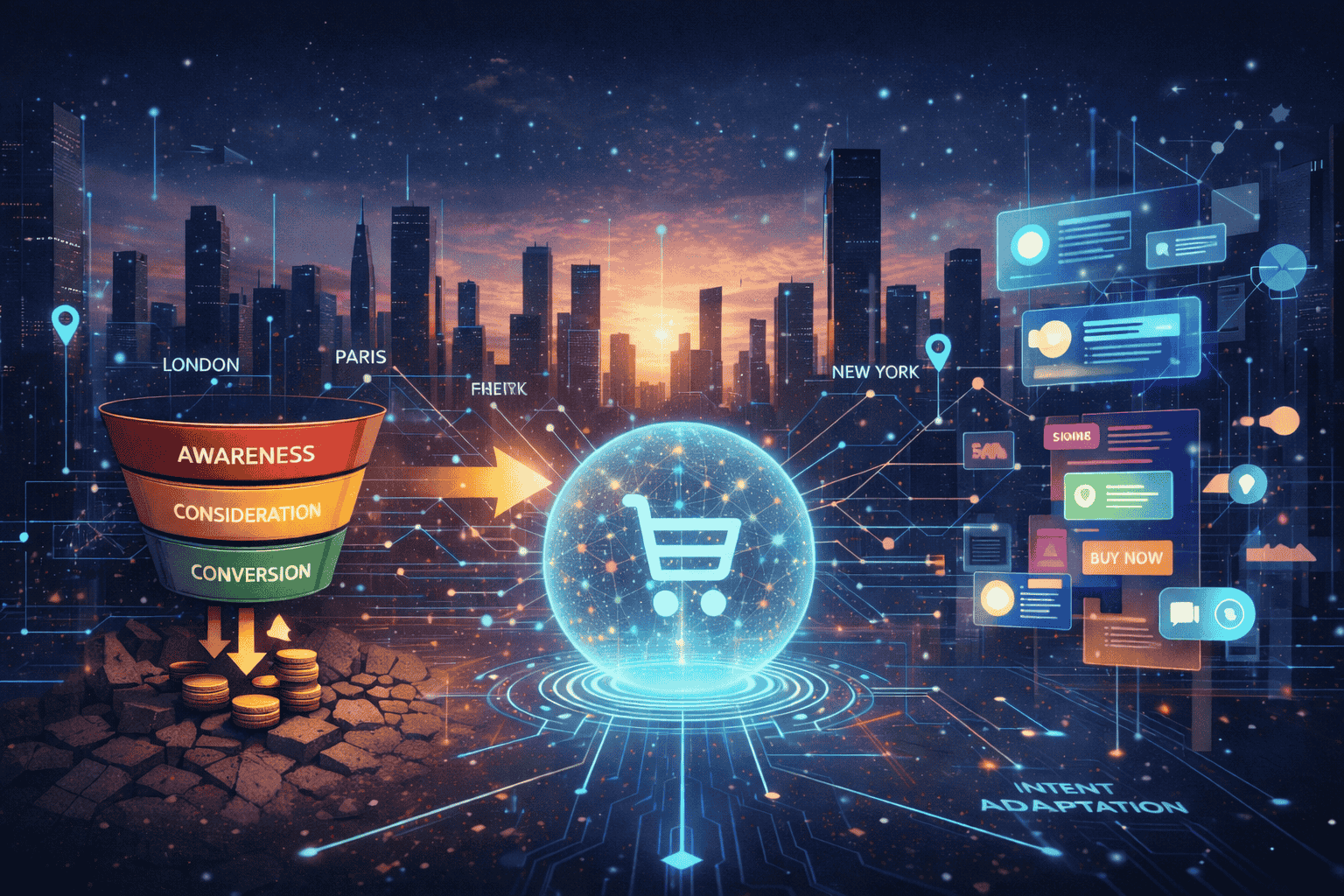
For years, marketers have sworn by funnels. Awareness at the top, conversion at the bottom, and a neat little journey in between. It looked tidy on slides and comforting in reports. But here’s the truth most brands are now quietly admitting: funnels don’t reflect reality anymore. In 2026, customers won't move in straight lines. They bounce, pause, compare, disappear, and return when you least expect it. Trying to force this behaviour into a rigid funnel is like fitting a round peg into a square hole. It’s not that funnels were wrong, they’re just outdated.
This is where AI-driven journey optimization steps in and changes the game.
Funnels assume control. They assume you decide the path and users obediently follow it. Real people don’t work that way. Today’s users arrive with wildly different intent. Some are just browsing. Some are price-checking. Others are ready to buy but need one last nudge. Treating all of them the same is where most conversion rate optimization services fall short.
Optimising a page without understanding the person on it is like rearranging furniture in a dark room. You might improve something, but you’re guessing.
Funnels also struggle with modern touchpoints. A buyer might discover you on Instagram, read reviews on Google, compare prices on a marketplace, and finally convert via email days later. No single funnel can capture that chaos, and trying to force it only creates blind spots.
Instead of asking, “How do we move users to the next step?”
High-performing brands now ask, “What does this user need right now?”
That shift is subtle, but powerful. AI allows brands to optimise journeys in real time. It analyses behaviour as it happens, scroll depth, hesitation, repeat visits, device usage, and adapts the experience accordingly. Two users landing on the same page might see different messaging, different CTAs, even different layouts.
This isn’t manipulation. It’s relevant. The website stops behaving like a static brochure and starts acting like a smart guide that knows when to speak, when to reassure, and when to get out of the way.
AI doesn’t replace human creativity. It replaces guesswork. Instead of running endless A/B tests hoping for marginal gains, AI looks at patterns humans can’t process at scale. It identifies where users stall, what combinations of content lead to action, and which journeys result in long-term value, not just quick conversions.
For example, one user might need social proof before buying. Another might need urgency. A third might just want a faster checkout. AI helps deliver the right cue at the right moment.
This is conversion optimization that feels less like pushing and more like helping.
In ecommerce, traffic is expensive and patience is thin. Pouring money into ads without fixing the journey is like filling a leaky bucket.
Modern ecommerce performance marketing isn’t just about driving clicks anymore. It’s about making sure every visit counts.
AI-led journey optimisation improves:
Product discovery based on intent
Checkout speed for high-intent users
Personalised recommendations without being intrusive
Retention by learning what keeps customers coming back
The result isn’t just higher conversion rates. It’s better customers, ones who return, spend more, and trust your brand.
Not entirely. Funnels still work as rough frameworks. But they’re no longer the engine. Think of funnels as maps. Helpful, but limited. AI-driven systems are more like GPS, constantly recalculating based on real-world conditions. The future isn’t about rigid steps. It’s about responsive systems that evolve as behaviour changes.
Here’s the part most brands miss. AI doesn’t magically make marketing better. It simply makes decisions clearer. When you understand why users hesitate, where they drop off, and what actually nudges them forward, everything else improves messaging, design, even creativity. Good marketing has always been about empathy. AI just helps scale it.
Funnels aren’t dead because they failed. They’re fading because people changed. In 2026, growth belongs to brands that stop forcing journeys and start listening to them. Brands that design systems, not sequences. Brands that optimise for humans first and algorithms second.
At HyperRevamp, we don’t obsess over funnels. We build intelligent conversion systems that learn, adapt, and grow with your audience. Because real journeys aren’t linear, and your optimisation strategy shouldn’t be either.